AI for Robotics represents the meeting point between intelligence and motion — where algorithms think, sensors perceive, and machines act with purpose. It’s the frontier where data becomes dexterity, powering the next generation of autonomous systems, industrial robots, and intelligent machines.
In these instructor-led live training courses, participants explore how artificial intelligence transforms robotics into adaptive, learning systems. Through hands-on exercises, they dive into perception models, motion planning, reinforcement learning, and AI-driven control architectures that bring machines closer to human-like responsiveness.
Those joining online enter an environment that mirrors the pace of real labs — guided step by step through live demonstrations and collaborative coding via an interactive remote desktop. Every session unfolds as a shared exploration of logic and movement, not a one-way lecture.
For teams who prefer to build and test side by side, onsite live training in Sofia — held at customer premises or within NobleProg corporate training centers — transforms learning into experimentation. Robots, code, and imagination meet in a practical space where theory takes physical form.
Also known as Robotics AI or Intelligent Robotics, our training helps professionals bridge software and mechanics — building systems that sense, decide, and act with increasing autonomy and precision.
NobleProg — Your Local Training Provider
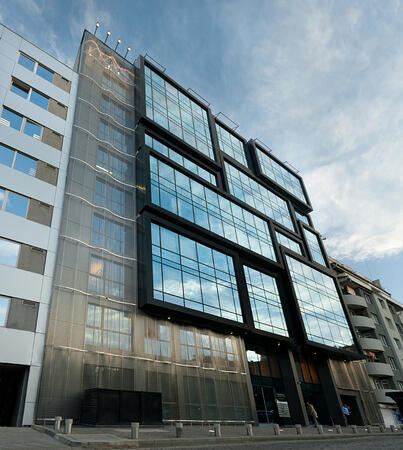
Crystal Business Center
ул. "Осогово" 40, Sofia, Bulgaria, 1303
Crystal Business Center is located in the central part of Sofia, on the corner of "Osogovo" street. and "Todor Aleksandrov" blvd. The building is easily accessible by metro (only 50 m from Opalchenska station) and other public transport. Its total area is 8000 sq.m. The office area is 6171 sq.m.
This hands-on course, "Practical Rapid Prototyping for Robotics with ROS 2 & Docker," is designed to assist developers in efficiently building, testing, and deploying robotic applications. Participants will acquire the skills to containerize robotics environments, integrate ROS 2 packages, and create modular robotic systems using Docker, ensuring both reproducibility and scalability. The curriculum emphasizes agility, version control, and collaborative practices ideal for early-stage development and innovation teams.
Delivered by an instructor, this live training (available online or onsite) targets beginner to intermediate-level participants aiming to accelerate their robotics development workflows using ROS 2 and Docker.
Upon completion of this training, participants will be able to:
Configure a ROS 2 development environment within Docker containers.
Develop and test robotic prototypes in modular, reproducible setups.
Utilize simulation tools to validate system behavior prior to hardware deployment.
Collaborate effectively through containerized robotics projects.
Implement continuous integration and deployment concepts within robotics pipelines.
Format of the Course
Interactive lectures and demonstrations.
Hands-on exercises involving ROS 2 and Docker environments.
Mini-projects centered on real-world robotic applications.
Course Customization Options
To request a customized training for this course, please contact us to arrange.
Human-Robot Interaction (HRI): Voice, Gesture & Collaborative Control is a practical course aimed at introducing participants to the design and development of intuitive interfaces for human–robot communication. The training integrates theory, design principles, and programming practice to create natural and responsive interaction systems utilizing speech, gesture, and shared control methods. Participants will learn to integrate perception modules, develop multimodal input systems, and design robots that collaborate safely with humans.
This instructor-led, live training (available online or onsite) targets beginner to intermediate-level participants seeking to design and implement human–robot interaction systems that improve usability, safety, and user experience.
Upon completion of this training, participants will be able to:
Grasp the foundations and design principles of human–robot interaction.
Develop voice-based control and response mechanisms for robots.
Implement gesture recognition using computer vision techniques.
Design collaborative control systems for safe and shared autonomy.
Evaluate HRI systems based on usability, safety, and human factors.
Format of the Course
Interactive lectures and demonstrations.
Hands-on coding and design exercises.
Practical experiments in simulation or real robotic environments.
Course Customization Options
To request a customized training for this course, please contact us to arrange.
Industrial Robotics Automation: Integrating ROS with PLCs and Digital Twins is a practical, hands-on course designed to bridge the gap between industrial automation and contemporary robotics frameworks. Participants will learn how to seamlessly integrate ROS-based robotic systems with PLCs to achieve synchronized operations. The course also explores digital twin environments, enabling learners to simulate, monitor, and optimize production processes. A strong emphasis is placed on interoperability, real-time control, and predictive analysis utilizing digital replicas of physical systems.
This instructor-led live training (available online or onsite) targets intermediate-level professionals seeking to develop practical skills in connecting ROS-controlled robots with PLC environments and implementing digital twins to enhance automation and manufacturing efficiency.
Upon completion of this training, participants will be able to:
Grasp the communication protocols used between ROS and PLC systems.
Implement real-time data exchange mechanisms between robots and industrial controllers.
Create digital twins for monitoring, testing, and simulating processes.
Integrate sensors, actuators, and robotic manipulators into industrial workflows.
Design and validate industrial automation systems using hybrid simulation environments.
Course Format
Interactive lectures and architectural walkthroughs.
Hands-on exercises focused on integrating ROS and PLC systems.
Implementation of simulation and digital twin projects.
Customization Options
For a tailored training experience, please contact us to arrange your customized course.
This advanced course, "Robotic Manipulation and Grasping Using Deep Learning," connects the principles of robotic control with contemporary machine learning methodologies. Students will investigate how deep learning can improve perception, motion planning, and dexterous grasping capabilities within robotic systems. By combining theoretical knowledge, simulations, and hands-on coding tasks, the curriculum leads learners from perception-driven control mechanisms to end-to-end policy learning for complex manipulation assignments.
This live training session, available both online and in person, is instructed by an expert and targets seasoned professionals seeking to utilize deep learning algorithms to create intelligent, adaptable, and precise robotic manipulation systems.
Upon completion of this training, participants will have mastered the following skills:
Create perception models for object recognition and pose estimation.
Train neural networks designed for grasp detection and motion planning.
Combine deep learning modules with robotic controllers using ROS 2.
Simulate and assess grasping and manipulation strategies within virtual environments.
Deploy and optimize learned models on actual or simulated robotic arms.
Course Format
Lectures led by experts featuring deep dives into algorithms.
Practical coding and simulation exercises.
Implementation and testing through project-based learning.
Customization Options
To arrange customized training for this course, please contact us.
Multi-Robot Systems and Swarm Intelligence is an advanced training program designed to delve into the architecture, coordination, and management of robotic teams, drawing inspiration from biological swarm dynamics. Participants will acquire skills in modeling interactions, executing distributed decision-making processes, and optimizing collaborative efforts across various agents. This course integrates theoretical foundations with practical simulation exercises to equip learners with the expertise needed for applications in logistics, defense, search and rescue operations, and autonomous exploration.
Delivered by an instructor, this live training is available both online and on-site, targeting advanced professionals who aim to design, simulate, and deploy multi-robot and swarm-based systems utilizing open-source frameworks and algorithms.
Upon completion of this training, participants will be capable of:
Grasping the core principles and dynamics governing swarm intelligence and cooperative robotics.
Developing communication and coordination strategies tailored for multi-robot environments.
Executing distributed decision-making processes and consensus algorithms.
Simulating collective behaviors including formation control, flocking, and coverage tasks.
Applying swarm-based methodologies to real-world challenges and optimization problems.
Format of the Course
Advanced lectures featuring deep dives into algorithms.
Practical coding and simulation exercises using ROS 2 and Gazebo.
A collaborative project focused on applying swarm intelligence principles.
Course Customization Options
To arrange a customized training session for this course, please contact us.
TinyML represents a framework designed for deploying machine learning models on low-power microcontrollers and embedded platforms, particularly within the realms of robotics and autonomous systems.
This instructor-led live training, available either online or onsite, targets advanced professionals seeking to incorporate TinyML-based perception and decision-making capabilities into autonomous robots, drones, and intelligent control systems.
After completing this course, participants will be equipped to:
Design optimized TinyML models tailored for robotics applications.
Implement on-device perception pipelines to enable real-time autonomy.
Integrate TinyML into established robotic control frameworks.
Deploy and evaluate lightweight AI models on embedded hardware platforms.
Course Format
Technical lectures paired with interactive discussions.
Hands-on labs centered on embedded robotics tasks.
Practical exercises that simulate real-world autonomous workflows.
Customization Options
For organizations with specific robotics environments, customization can be arranged upon request.
Safe & Explainable Robotics offers a comprehensive training program dedicated to the safety, verification, and ethical governance of robotic systems. This course connects theoretical concepts with practical applications by examining safety case methodologies, hazard analysis, and explainable AI approaches that enhance the transparency and trustworthiness of robotic decision-making. Participants will acquire the skills necessary to ensure compliance, verify system behaviors, and document safety assurance in accordance with international standards.
This instructor-led, live training (available online or onsite) is designed for intermediate-level professionals seeking to apply verification, validation, and explainability principles to guarantee the safe and ethical deployment of robotic systems.
Upon completion of this training, participants will be able to:
Create and document safety cases for robotic and autonomous systems.
Apply verification and validation techniques within simulation environments.
Gain an understanding of explainable AI frameworks used in robotic decision-making.
Integrate safety and ethical principles into system design and operational processes.
Effectively communicate safety and transparency requirements to stakeholders.
Format of the Course
Interactive lectures and discussions.
Practical exercises involving simulation and safety analysis.
Case studies derived from real-world robotics applications.
Course Customization Options
For inquiries regarding customized training for this course, please contact us to arrange your session.
Edge AI allows artificial intelligence models to operate directly on embedded or resource-limited devices, which reduces latency and power usage while enhancing autonomy and privacy in robotic systems.
This instructor-led, live training (available online or onsite) targets intermediate-level embedded developers and robotics engineers aiming to implement machine learning inference and optimization techniques directly on robotic hardware using TinyML and edge AI frameworks.
Upon completing this training, participants will be able to:
Grasp the fundamentals of TinyML and edge AI in robotics.
Convert and deploy AI models for on-device inference.
Optimize models for speed, size, and energy efficiency.
Integrate edge AI systems into robotic control architectures.
Evaluate performance and accuracy in real-world scenarios.
Course Format
Interactive lectures and discussions.
Hands-on practice with TinyML and edge AI toolchains.
Practical exercises on embedded and robotic hardware platforms.
Course Customization Options
To request customized training for this course, please contact us to arrange it.
This instructor-led live training in Sofia (online or onsite) targets intermediate-level participants interested in exploring the role of collaborative robots (cobots) and other human-centric AI systems in modern workplaces.
Upon completing this training, participants will be capable of:
Grasping the principles of Human-Centric Physical AI and its practical applications.
Exploring how collaborative robots contribute to enhanced workplace productivity.
Recognizing and resolving challenges related to human-machine interactions.
Developing workflows that maximize collaboration between humans and AI-driven systems.
Fostering a culture of innovation and adaptability within AI-integrated workplaces.
Reinforcement learning (RL) is a machine learning approach where agents acquire decision-making skills through interaction with their surroundings. In the field of robotics, RL empowers autonomous systems to develop adaptive control and decision-making capabilities by leveraging experience and feedback.
This instructor-led, live training, available either online or onsite, is designed for advanced-level machine learning engineers, robotics researchers, and developers who aim to design, implement, and deploy reinforcement learning algorithms within robotic applications.
Upon completion of this training, participants will be capable of:
Gaining a solid understanding of the principles and mathematical foundations of reinforcement learning.
Implementing RL algorithms including Q-learning, DDPG, and PPO.
Integrating RL with robotic simulation environments using OpenAI Gym and ROS 2.
Enabling robots to perform complex tasks autonomously through trial and error.
Enhancing training performance via deep learning frameworks such as PyTorch.
Course Format
Interactive lectures and discussions.
Practical implementation using Python, PyTorch, and OpenAI Gym.
Hands-on exercises in simulated or physical robotic environments.
Customization Options
To arrange customized training for this course, please contact us directly.
OpenCV serves as an open-source library for computer vision, facilitating real-time image processing, while deep learning frameworks like TensorFlow supply the necessary tools for intelligent perception and decision-making within robotic systems.
This instructor-led, live training (available online or onsite) targets intermediate-level robotics engineers, computer vision specialists, and machine learning engineers aiming to apply computer vision and deep learning methodologies to enhance robotic perception and autonomy.
Upon completion of this training, participants will be equipped to:
Build computer vision pipelines utilizing OpenCV.
Integrate deep learning models for object detection and recognition tasks.
Leverage vision-based data to control and navigate robots.
Merge classical vision algorithms with deep neural networks.
Deploy computer vision solutions on embedded and robotic platforms.
Format of the Course
Interactive lectures and discussions.
Practical exercises using OpenCV and TensorFlow.
Live-lab implementation on either simulated or physical robotic systems.
Course Customization Options
To request a customized training session for this course, please reach out to us to make arrangements.
This instructor-led, live training in Sofia (online or onsite) is designed for advanced robotics engineers and AI researchers aiming to utilize Multimodal AI. The objective is to integrate various sensory inputs to develop highly autonomous and efficient robots capable of seeing, hearing, and touching.
By the end of this training, participants will be able to:
Implement multimodal sensing in robotic systems.
Develop AI algorithms for sensor fusion and decision-making.
Create robots that can perform complex tasks in dynamic environments.
Address challenges in real-time data processing and actuation.
Smart Robotics involves incorporating artificial intelligence into robotic systems to enhance perception, decision-making, and autonomous control.
This instructor-led, live training (online or onsite) is aimed at advanced-level robotics engineers, systems integrators, and automation leads who wish to implement AI-driven perception, planning, and control in smart manufacturing environments.
By the end of this training, participants will be able to:
Understand and apply AI techniques for robotic perception and sensor fusion.
Develop motion planning algorithms for collaborative and industrial robots.
Deploy learning-based control strategies for real-time decision making.
Integrate intelligent robotic systems into smart factory workflows.
Format of the Course
Interactive lecture and discussion.
Lots of exercises and practice.
Hands-on implementation in a live-lab environment.
Course Customization Options
To request a customized training for this course, please contact us to arrange.
ROS 2 (Robot Operating System 2) is an open-source framework designed to support the development of complex and scalable robotic applications.
This instructor-led, live training (online or onsite) is aimed at intermediate-level robotics engineers and developers who wish to implement autonomous navigation and SLAM (Simultaneous Localization and Mapping) using ROS 2.
By the end of this training, participants will be able to:
Set up and configure ROS 2 for autonomous navigation applications.
Implement SLAM algorithms for mapping and localization.
Integrate sensors such as LiDAR and cameras with ROS 2.
Simulate and test autonomous navigation in Gazebo.
Deploy navigation stacks on physical robots.
Format of the Course
Interactive lecture and discussion.
Hands-on practice using ROS 2 tools and simulation environments.
Live-lab implementation and testing on virtual or physical robots.
Course Customization Options
To request a customized training for this course, please contact us to arrange.
This instructor-led, live training in Sofia (online or onsite) is aimed at intermediate-level participants who wish to enhance their skills in designing, programming, and deploying intelligent robotic systems for automation and beyond.
By the end of this training, participants will be able to:
Understand the principles of Physical AI and its applications in robotics and automation.
Design and program intelligent robotic systems for dynamic environments.
Implement AI models for autonomous decision-making in robots.
Leverage simulation tools for robotic testing and optimization.
Address challenges such as sensor fusion, real-time processing, and energy efficiency.
The intersection of Artificial Intelligence (AI) and Robotics leverages machine learning, control systems, and sensor fusion to build intelligent machines capable of autonomous perception, reasoning, and action. By utilizing contemporary tools such as ROS 2, TensorFlow, and OpenCV, engineers can design robots that intelligently navigate, plan routes, and interact with physical environments.
This instructor-led live training, available either online or on-site, targets intermediate-level engineers looking to develop, train, and deploy AI-powered robotic systems using modern open-source technologies and frameworks.
Upon completion of this training, participants will be able to:
Utilize Python and ROS 2 to construct and simulate robotic behaviors.
Deploy Kalman and Particle Filters for precise localization and tracking.
Apply computer vision techniques via OpenCV for perception and object detection.
Employ TensorFlow for motion prediction and learning-based control mechanisms.
Integrate SLAM (Simultaneous Localization and Mapping) to enable autonomous navigation.
Create reinforcement learning models to enhance robotic decision-making capabilities.
Course Format
Interactive lectures and discussions.
Practical implementation exercises using ROS 2 and Python.
Hands-on practice with both simulated and real-world robotic environments.
Customization Options
For information on arranging a customized training session for this course, please contact us directly.
In this instructor-led, live training held in Sofia (online or onsite), participants will explore the technologies, frameworks, and techniques necessary for programming various robots for use in nuclear technology and environmental systems.
The course spans six weeks, meeting five days a week. Each day involves four hours of lectures, discussions, and hands-on robot development in a live lab environment. Participants will complete real-world projects applicable to their work to practice their acquired knowledge.
The course targets hardware simulated in 3D via simulation software. Programming the robots will utilize the ROS (Robot Operating System) open-source framework, C++, and Python.
By the end of this training, participants will be able to:
Understand the key concepts used in robotic technologies.
Understand and manage the interaction between software and hardware in a robotic system.
Understand and implement the software components that underpin robotics.
Build and operate a simulated mechanical robot that can see, sense, process, navigate, and interact with humans through voice.
Understand the necessary elements of artificial intelligence (machine learning, deep learning, etc.) applicable to building a smart robot.
Implement filters (Kalman and Particle) to enable the robot to locate moving objects in its environment.
Implement search algorithms and motion planning.
Implement PID controls to regulate a robot's movement within an environment.
Implement SLAM algorithms to enable a robot to map out an unknown environment.
Extend a robot's ability to perform complex tasks through Deep Learning.
Test and troubleshoot a robot in realistic scenarios.
Azure Bot Service unites the strengths of the Microsoft Bot Framework and Azure Functions, offering a robust platform for rapidly constructing intelligent chatbots.
During this instructor-led live training, attendees will learn how to effectively create smart bots using Microsoft Azure.
Upon completing the training, participants will be capable of:
Grasping the fundamental concepts behind intelligent bots.
Developing intelligent bots through cloud-based applications.
Acquiring practical expertise in the Microsoft Bot Framework, the Bot Builder SDK, and Azure Bot Service.
Implementing established bot design patterns in real-world scenarios.
Creating and deploying their first intelligent bot using Microsoft Azure.
Target Audience
This course is tailored for developers, hobbyists, engineers, and IT professionals with an interest in bot development.
Course Format
The training blends lectures and discussions with exercises, placing a strong emphasis on hands-on practice.
A bot, or chatbot, functions as a virtual assistant designed to automate user interactions across various messaging platforms. This allows tasks to be completed more quickly without requiring direct communication with a human agent.
During this instructor-led live training, participants will learn how to begin developing a bot by stepping through the creation of sample chatbots using specific development tools and frameworks.
By the conclusion of this training, participants will be able to:
Comprehend the various uses and applications of bots
Understand the complete bot development lifecycle
Explore the different tools and platforms utilized in building bots
Construct a sample chatbot for Facebook Messenger
Construct a sample chatbot using the Microsoft Bot Framework
Target Audience
Developers interested in building their own bot
Course Format
A combination of lectures, discussions, exercises, and extensive hands-on practice
This instructor-led live training in Sofia (online or onsite) is designed for engineers who wish to learn about the applicability of artificial intelligence to mechatronic systems.
By the end of this training, participants will be able to:
Gain an overview of artificial intelligence, machine learning, and computational intelligence.
Understand the concepts of neural networks and different learning methods.
Choose artificial intelligence approaches effectively for real-life problems.
Implement AI applications in mechatronic engineering.
A Smart Robot is an Artificial Intelligence (AI) system capable of learning from its environment and experiences to expand its capabilities based on that acquired knowledge. These robots can collaborate with humans, working alongside them and learning from their behavior. They are equipped not only for manual labor but also for cognitive tasks. In addition to physical robots, Smart Robots can be entirely software-based, residing in a computer as an application without moving parts or physical interaction with the real world.
In this instructor-led live training, participants will explore the various technologies, frameworks, and techniques required to program different types of mechanical Smart Robots, then apply this knowledge to complete their own Smart Robot projects.
The course is divided into 4 sections, each comprising three days of lectures, discussions, and hands-on robot development in a live lab environment. Each section concludes with a practical hands-on project, allowing participants to practice and demonstrate their newly acquired knowledge.
The target hardware for this course will be simulated in 3D using simulation software. The ROS (Robot Operating System) open-source framework, along with C++ and Python, will be used for programming the robots.
By the end of this training, participants will be able to:
Understand the key concepts used in robotic technologies
Understand and manage the interaction between software and hardware in a robotic system
Understand and implement the software components that underpin Smart Robots
Build and operate a simulated mechanical Smart Robot capable of seeing, sensing, processing, grasping, navigating, and interacting with humans through voice
Extend a Smart Robot's ability to perform complex tasks through Deep Learning
Test and troubleshoot a Smart Robot in realistic scenarios
Audience
Developers
Engineers
Format of the course
Part lecture, part discussion, exercises, and heavy hands-on practice
Note
To customize any part of this course (programming language, robot model, etc.), please contact us to arrange.
Read more...
Last Updated:
Testimonials (2)
Supply of the materials (virtual machine) to get straight into the excersises, and the explanation of the Ros2 core. Why things work a certain way.
Arjan Bakema
Course - Autonomous Navigation & SLAM with ROS 2
its knowledge and utilization of AI for Robotics in the Future.
Ryle - PHILIPPINE MILITARY ACADEMY
Course - Artificial Intelligence (AI) for Robotics
Online Robotics AI training in Sofia, Intelligent Robotics training courses in Sofia, Weekend Intelligent Robotics courses in Sofia, Evening Intelligent Robotics training in Sofia, Robotics AI instructor-led in Sofia, AI for Robotics boot camp in Sofia, Evening AI for Robotics courses in Sofia, Robotics AI trainer in Sofia, Intelligent Robotics on-site in Sofia, AI for Robotics private courses in Sofia, AI for Robotics one on one training in Sofia, Online AI for Robotics training in Sofia, Robotics AI classes in Sofia, Intelligent Robotics instructor-led in Sofia, AI for Robotics instructor in Sofia, Intelligent Robotics coaching in Sofia, Weekend AI for Robotics training in Sofia